SMS: The Most Important Things!

A couple years ago I began praying this prayer: “Lord, will you free me up to do the things you’ve most gifted me to do and the things for which I have the most passion?”

In fact, I remember it was November of 2007 I began to pray that prayer.  Though my job has changed (was a Vocational Youth Pastor then), this prayer continues to be my prayer.  Some may find it strange that I continue to pray that prayer even though I am leading an organization and more specifically, one that I started.

No, I am not looking to leave Youthmark. I simply want to continue to pray that prayer.  I believe that God has gifted me in specific ways and given me passion in specific areas, I simply want to obey Him and be used for Him.  I hope you have a similar response (and prayer).

What Would That Look Like?

If God ultimately answered that prayer, I would be freed up to write and speak.

I’d like to continue to shepherd Youth Pastors, Leaders, Parents and Teens.  I believe the most important things I could write and speak about would be along the lines of:

  • disciplEship: I’d like to see the “E” put back in this word.  I believe that many churches (and Christians) have prioritized Bible study, fellowship groups, potlucks, worship and sometimes service projects.  We’ve taught the younger generation to prioritize Youth Group, accountability partnerships, lock-ins and fundraising.  These are all things that can and sometimes should be prioritized, but what about our neighbor?  What about our co-worker?  What about our unsaved friends?  Lord, will you free me up to write and speak, but most importantly, free me up to live and speak out your love and grace to those who do not know you.
  • relational evangelism: I’d love to help students, parents, pastors, leaders… well, Christians, understand that practical, relational evangelism IS our most practical way to worship Jesus day in and day out.  To me, this is our spiritual act of worship. First, I love mission trips, but let’s be honest, it’s a lot easier to share your faith on a mission trip than it is in our own Jerusalem.  The fear-factor of being rejected  “over there” (“there” being defined as anywhere outside our own home-area) is minimized.  Being rejected for sharing Christ “there” doesn’t hurt as much as a loved-one, best friend or even a stranger rejecting you in your own town.  It should hurt everywhere! In fact, Paul describes his “fear and trembling” he had in 1 Corinthians 2.  On his mission trip to Corinth, he admits to the fear of rejection, only his fear was “fear for rejection.”  He feared that those he related with and shared the great news to, would ultimately reject that grace.  He feared for their (eternal) lives (not his).  I want to help others understand that relational evangelism (by serving, loving and sharing) is good anywhere!  I want to write and speak and live in such a way that helps others to see their neighbor, co-worker, relative and the uttermost as people who need to hear about Christ! This effort needs to be renewed, it’s not just about memorization, wrote answers and laws.  It’s about practical training that every Christian understand his/her responsibility and calling. Lord, please free me up to write and speak more effectively so that we learn to relationally and lovingly share the Gospel with all!
  • practice makes (others) perfect. I want to help people understand Scripture in such a way that they/we practice what we read.  Ultimately as we get to know the Word of God and trust in the Spirit of God we can apply the things we are learning in Scripture.  As we “practice” these things we will play a role in the lives of others.  Our motivation/call to “love God and love others” plays out in meeting the needs within the four walls and extends to the four corners!  Practicing Scripture means loving the lost.  Not just loving them by telling them they need the Gospel, but loving them by showing them how the Gospel is lived out.  To me this means meeting practical needs of others (here and abroad).  I believe in social justice causes. This comes from knowing Scripture and practicing what we read.  Meeting physical needs opens up opportunities to share the spiritual answer.  In the end, when God calls His children to Himself, they will be made perfect by the blood of the Lamb!  Our practice, could lead to Him making them perfect! Lord, would you free me up to write and speak to others about Your Word.  Your Word and Your Spirit will transform your people and ultimately reach more people with the Gospel!

You being “freed up” may look a little different than what it looks like for me.  My hope is that you’ll see the priority and emphasis as the result of my prayer is simply to glorify Him with the things He has gifted us to do!  May you be freed up to do that which is most important to Him!

Grace,

Brian
 

SMS: Multi-Group Events

  • Peanut Butter slathered on celery.
  • Nacho Cheese Doritos dipped in hot mustard.
  • French Fries dipped in a Wendy’s Frosty
  • Baptists, Nazarenes and Methodists dipped in a Covenant Church All-Nighter.

Odd combinations.  But ones that work really well for me.

Some churches and youth leaders are very open to doing cross-church and cross denominational events.  Others are not.  Some are open to it because they have experienced great success in the past.  I know plenty who are against the idea of doing events as a network because they’ve been burned, ignored or “had to do it all myself”  in the past.

Our Student Ministry Stuff (SMS) post today gives some practical advice on how and why larger group events/cross denominational events can work well.  In addition it should point out a few of the warning signs to avoid.

My perspective on this subject is somewhat shaped by my regional background.  In the northwest corner of the United States are a few of the most unchurched states.  We don’t do professional church very well. In my area a church is considered “big” if you have over 400 people in attendance.  A “mega” church in the northwest is a church over 1000.  Denominationalism does exists, but to a much lesser degree as I have seen it in the mountains, south and southwest. As a whole, the Youth Pastors I have dealt with in the NW are not overly concerned with theological i-dotting and t-crossing when it comes to reaching the lost students.  This is not always the case and certainly isn’t always the case when it comes to the rest of the church leadership (in other words, there are certainly some “boards” who tell their YP’s not to do events with that church because of specific stands and non-stands).

I am an advocate for teamwork, unity and multi-group/church effort, especially when it comes to reaching those who do not know Jesus.  I do believe we are better together; I’d like to see better efforts made together to reach our campuses, clubs, community and even our churches for Christ.  I really don’t care about the size of church (interesting of the “big church” often gets finger(s) pointed at them, sometimes rightfully so for thinking they have it together and sometimes wrongfully just because “they’re big).  I am simply an advocate for the Christian Community understand that we can be better together! Here’s how I think multi-church events can work better.

Relationship: I believe the best group events flow out of the relationships represented in the leadership.  Group events rarely work well when the the people leading them are not committed to each other first.  As humans (read: sinners) we’re prone to hide and blame (especially when things go wrong or difficulties arise).  When the cross-denominational leaders are first and foremost committed to the Lord and to each other and the long-term relationship it seems an agenda for an event flows out of their united hearts. As Youth Leaders get to know one another and acquaintance relationships move to Gospel-centric friendships the trust-level grows and the success level of a given event seems to rise up as well.  Bottom line: Look to do events with others as a result of the relationship not to forge a relationship.

Ownership: The best group events are the ones where ownership aspects are given to each participating group.  Recently while traveling I heard, “I don’t know why other churches don’t join us for our worship nights?  We have a great band, great sound and lighting equipment, our Youth Pastor knocked it out of the park with his message and the testimony from the homecoming queen, she goes to our church, was amazing.”  I have personally attended worship nights at other churches to check it out, at times it has felt like more of an effort to sheep-steal than “group worship night.”  I’ve seen camps, retreats, youth rally’s and worship nights work really well for group situations –the common denominator has always been “group ownership.”  I’ve seen many camps, retreats, missions, youth rally’s and worship nights fall flat as well; the common denominator in these settings has typically been single-church ownership. Take the “worship night” example.  Church A has the great worship band, equipment, setting, etc.–let them head up the event and host the event.  Church B can provide the person giving the testimony while Church C does the “upfront” skit, game or artwork.  Church D has a very talented keyboardist and soloist who provide the background music during an alter call?  Guess what, church E, which is much smaller, decided to participate by simply bringing the large Igloo containers full of Tang!  Well, we now had 5 churches participating and each had ownership. The same can be done with camps, rally’s or missions… transportation, speaking, worship, shirt-design, games, etc. can all be divided so that ownership is created!  Bottom line: You may have a GREAT event in mind but if you’re the only one who owns the event your group is probably the only group that will attend the event.

Simplicity: Know the primary purpose of any group setting and keep it simple and focussed. Understand that theological bents may prevent you from doing some events (dances, worship concerts where “tongues” is encouraged, even communion and baptism could be issues that bring theological division).  Doing an “overnighter” where the purpose is to bring unchurched friends into a setting where the unbeliever can see Christians have a lot fun together is a simple purpose.  In this setting the leadership should decide together if and who will be speaking and what the message will be (I will always suggest the Gospel be the focus).  I’ve seen groups get in trouble when they’ve tried to take on “training” events in cross-denominational settings.  Who is the speaker?  What theology will he or she bring?  What is their view on the end-times?  Keeping things simple and focussed with a single purpose of “outreach,” “encouragement,” “worship” or “service” has seemed to bring about more success than more complex purposes.  Bottom Line: If you’re aiming at nothing, you’re bound to hit it.  Know the primary purpose of a group event and be clear in communicating that purpose before, during and after.

Keeping group events simple, giving ownership to each group involved flowing out of already existing relationships of the leadership should lead to greater unity in the larger Christian community.  As I read 1 Corinthians 12 and see how the Lord has formed the body to work together I am greatly encouraged and see how we, even cross denominationally, can better glorify Jesus as we are freed up to do that which he has equipped and gifted us to do!

Grace,

Brian

600 Club!

Blog post #600!

A lot has happened in the last 2 and half years, I am happy to say that a lot of my life (and Youthmark’s life) has been recorded in this online journal format.

Just a fun little survey to find out what you like best about the blog… So, if there is anything you’re particularly fond of, pick it (multiple selections are possible).

Thanks for stopping by, I hope you continue to stop by! Here’s to the next 600 posts.

Grace,
Brian

SMS: Re-Thinking Missions

Let’s start with a fun question:

If you could go anywhere in the world on a mission trip, where would you want to go and why?

Australia?  Italy?  Scotland?  Costa Rica? Haiti? East Africa?  Russia?

The location list is endless. But which one came first to your mind?

My guess is that not one of us named our home town, our neighborhood, our campus, or our unsaved friend’s house.

Jesus said, “you will be my witnesses in Jerusalem (home town), and in all Judea (surrounding communities) and Samaria (similar territory, different culture), and to the ends of the earth (across the borders… all borders).”

Most are enamored with the uttermost, we want adventure, we like travel, we’re looking to serve Jesus with all our heart and we want other people groups to know and love Christ.  There is NOTHING wrong with any of these.

But what about our Jerusalem?  It’s very interesting that in the first full seven chapters of Acts we have not one written “witness” account outside of Jerusalem.  This means that the very men (the 11 remaining Apostles) Jesus trained emphasized local mission.  In essence the list Jesus gives in Acts 1:8 could be looked at as a priority list.

What if?

I believe a paradigm shift needs to take place.  One practical question Youth Leaders are asking (and being asked) right now is, “where are we going next year on the mission trip?”  Very practical question.  But what if our question became, “what are we doing right now to discern where God would have us go as we continue to reach our Jerusalem?  Emphasis on “as we continue to reach our Jerusalem.”

Even as persecution took place in Jerusalem ( Acts 8 ) the Apostles remained.  The first person we read of witnessing outside Jerusalem is the Deacon Philip in a city in Samaria.  How interesting that the Apostles remained reaching Jerusalem.

“There” is an option… for sure!

I don’t want to downplay the Judea, Samaria and uttermost options.  We certainly are still fulfilling the call from Acts 1:8, nearly 1/5 of the world’s population lives in areas where the Gospel is still not yet preached.  However, in my own experience and based on the pattern I see in Scripture, going to the uttermost is never the starting point.  I believe we must start with our Jerusalem.  We must train, equip and send our disciples to/for our own home-towns!  This is what we (Youthmark) call Mission51!  We desperately want our teams to have a wonderful mission experience for one week, however, we want all participants living out the mission the other 51 weeks of life!

“Here” is always!

Youth Pastors, I completely understand that you need to answer the “where?” question.  However, I believe you must first answer the “how do we do it here?” question.  In nearly 20 years of student ministry experience I believe I have the answer.  The answer is simple, and my 20 years is merely a reflection of the answer that was given 2000 years ago.  “Make Disciples.”

We must prepare our participants before, during and after a mission trip so that Mission51 is the end goal.  It’s not just an experience, it’s a life-time experience. Please hear my heart, some may see this as a shameless plug for Youthmark Mission Ventures, if that’s what you feel, you’ve missed the point.  This is a shameless plug to fall in love with the lost!

My challenge is for all of us to re-think Student Missions (actually, all missions).  By emphasizing Jerusalem and training folk before, during and after, the emphasis becomes full-time mission, not one-week experience where we hope to get a spiritual high.  No more should we have sign-up, raise funds then show-up mission trips.  It needs to be about faith-building, prayer-reliant, disciple-making training so that we’re prepared for “here and there.”

Whether you, or your church ever do a Youthmark trip or use our Youthmark training materials, my challenge remains: make disciples, not thrill seekers.  The end result is that the thrill-ride that Jesus has for our us in our own Jerusalem will far surpass the thrills of seeing new lands.  As friends and family members in our own communities come to Christ we will experience eternal joy with those we were closest to on earth.

The next few weeks are very important weeks in my life.  I’m doing preview lunches for Youthmark where I am gathering Youth Pastors for a free meal.  Many of these Youth Pastor are coming to the lunch to consider “where they may go” on a mission trip.  And while we REALLY want them to do a YMV, my heart is that they “get” Mission51.  We believe in our curriculums, camps and materials we give for before, during and after.  We love the places we’re going (Costa Rica, Mexico, virtually every western, mountain and southern state; Alaska, Hawaii and Canada). We believe we have priced our products below what anyone other organization is doing, we very much want people to get onboard because we believe “our Jerusalem” is just as spiritually needy as ANY other place.

Last note.

I wrote this blog post in San Jose, Costa Rica.  Where my world was rocked once again.  The needs in Costa Rica were many.  I cannot begin to tell you how excited I am that we (Youthmark) get to partner with our brothers and sisters down south.  However, I know the ONLY way to impact that (CR) community is to have students/leaders who do this as an act of obedience and a natural out-flow of their desire to reach their own Jerusalem! Mission51 is the needs to be the new emphasis!

Let’s re-think this stuff together!

If you would like to be a part of Mission51, please preview the materials/trips online here, if you’re in an area that has a preview lunch, please register here (you can see the complete list of lunches with that click).

Grace,

Brian

SMS: Help Me! I’m Busy (Part 2)

The Student Ministry Stuff (SMS) blog has been received well, I really have appreciated the encouraging words over the last couple months.  I’m pleased that the Lord has used these to bless youth leaders, parents and students since I began this weekly post.

Last week, in the first part of this SMS post, I tackled the subject of being “busy” from what I would call an analytical view (some place the emphasis on the first part of that word)… If you didn’t read that post, you may want to do that by clicking here.

This week, I want to take on this same subject but for those who are little bit more of the free-thinking bent, perhaps an abstract-random and maybe even a little ADD. The bottom-line, some people reject a disciplined “charts and graphs” scheduled lifestyle.  As I created the “chart” last week I knew that there would be many who would not resonate with the ideas presented.  Well, I hope this week I can help you with some different ideas that will help create space while still getting the things done that need to get done.  Keeping in mind the presenting problem… we’re trying to please all (if not most) of the people all (if not most) of the time.  Ultimately we know our call is to please God, but for some reason there just seems to be a high demand from people and we struggle with the idea of getting everything done that needs to get done.  It shouldn’t be just about keeping people pleased or “at bay,” but about excelling in our strengths and influencing the Kingdom and His children.

As we begin, know that you don’t have to choose between being a charts and graph scheduled pastor or an abstract random leader.  My guess is that most of us are a little bit of both. My hope becomes that either or both of these posts can help you become more efficient in your position.

Because there are many daily, weekly, monthly, quarterly and yearly demands it is easy to get buried in the just keeping up mode.  Feeling like you may sink and drown is not a pleasant feeling.  Missed appointments, unfinished tasks and last-minute prep can easily become the norm.  Well, here are a few simple suggestions (some may call the simplified systems) that may help.

  • First 15. I believe I’ve written about this in some other SMS blog post, but it’s a pretty simple principle to adopt.  In the first 15 minutes in the office (whether thats at a home office, coffee shop or your physical church office) set aside the first 15 minutes (or get to work 15 minutes earlier than normal) and set up your day.  This way you’re not so systematic that your every day is scheduled in advance, but your every day is in fact scheduled that day.  By way of example, lets say on a Tuesday morning I arrived at 8:45am knowing I had staff at 9:00am I would think through my day and the apparent pressures.  Let’s say these were my feelings:  I’m feeling like I’m way behind on my camp talks for this weekend.  I need to have a parent gathering soon, maybe sometime in the next month.  I haven’t started my prep for the games on Wednesday night and I have about six emails sitting in my inbox that probably will require 30-45 minutes.  In the first 15 minutes of my day, rather than doing work on ANY of these things I set up a block schedule (whether written down or just in my mind).  9-11 Staff; 11-1 emails and lunch; 1-3 camp talks and 3-4 games and other youth group prep and 4-5 camp talks again. Tomorrow, the stuff that didn’t get done will probably feel like a little more of a priority and the first 15 will held dictate my next day.
  • iText (or iEmail). When my wife wants to remind me of something she’d like for me to pick up at the grocery store she simply will email me or text it.  That way, I have a written record of the thing I need to buy.  Well, I’ve started to do this to myself.  iText or iEmail is the practice of communicating to myself.  So, as I have the thought “I need to email Bill, Joe and Sam” but don’t have the time to do that right now, I will text/email that to myself.  I then have a written reminder of a task I need to complete. Personally I have found email to be the better choice for me. Even at night, when sort-of mentally debriefing my day or clearing out messages I’ll come across that email and be reminded of those things that I need to do right then or prioritize for tomorrow. Sometimes a second email is sent so that it needs to be read the next morning upon arrival.  This “new school” to-do list gives me a feeling of satisfaction when I can delete the email because the task is completed (feels better than crossing off a list)!
  • Seasonal Scheduling. Go ahead, rebel against your own system!  Some of you need charts and graphs for short seasons.  So, using the concept from last week, set up for yourself a graph, knowing that for this season you’ll feel good about it.  But because you’re a natural rebel or not THAT self-disciplined I’d suggest you stick to the chart for as long as you can and when you see that it isn’t working, mix it up, change your hours, change the days you normally would do a task, etc.  In essence, be in the state of constant change.  However, I do suggest that through all of this, communicate well.  Nothing worse than an Admin, a Pastor or a Spouse thinking you’re doing one thing while you completely changed things up but didn’t tell them!
  • Network Accountability and/or Mentor. If you’re a part of a network or have someone who can hold  you accountable, I’d suggest you set up the communication with a person (in or out of your church) where the accountability partner can pray for you and hold you to the list of things you want to get done that next week.  This person may prove to not only be a pray partner, but someone who mentors you through the priority list for the week (or month).  Be warned, vulnerability might lead to some self-discovery and less of that Pied-Piper, “I can do it on my own” mentality (Praise God!).


Rather than being more verbose, I’d just say that this blog may be meant to whet your appetite on the subject.  I can explore/explain deeper if you’d like to engage any one of these more!

Know you’re not alone!  There are many who want to support you and help, it sometimes just doesn’t feel this way.  Praying for all you out there.  I hope I can help meet some practical needs!

Grace,
Brian

SMS: Help me! I’m busy! (part 1)

A good friend of mine, whom I consider very much “on the ball” as a Youth Pastor recently confessed to me that he’s really struggling with keeping his schedule straight and balanced while still trying to maintain his sanity as he navigates youth ministry, church ministry, family life, personal relationships, etc. etc.

Okay, this wasn’t a just a good friend.  It was four.  I literally have had the same conversation with four of my good youth pastor buddies in the last three weeks.  So, I thought I’d give this Student Ministry Stuff (SMS) blog post a shot at tackling the foundation of the Youth Pastor’s Time Management.

Some people are “charts and graphs” people.  Others reject them.  So I’m going to challenge myself to do a two week SMS blog post again and write to both those who can deal (or should deal) with the attempt at becoming organized with a thought-out plan (methodology). Next week I’ll try to get in the mind of a free-thinker and create a non-system way (philosophy) of taking on the busy schedule.  So, those who already reject me for being “chart-y” give it a shot anyway, and/or come back next week.

Let’s lay the cards out on the table right away–we  (Youth Pastors/Leaders) want to do well, we want to please others, we want others to like us.  But we feel like we’re failing a lot of the people a lot of the time.  It seems, as a Youth Leader (whether paid or not) that ministry never ends and there is always someone else we can be reaching out to, discipling, blessing or keeping off our backside.  Toby’s Mom wonders why you’re not giving Toby individual attention; the board member wonders why he didn’t see your truck at the office “at all” on Thursday?  Mr. Gregory emailed you about the most trivial theological discrepancy “he heard” you taught his daughter last Sunday. Unfortunately this may be your life:

Why didn’t you return my email?… Where are your receipts?… When is camp? How come we didn’t do more songs last night? Why do we sing so much? Can you fill-in for me this Sunday and preach? We used to have 40 at youth group, why are there only 32 now? Toby didn’t know about the mission trip application deadline, can he still turn in his form? Honey, how many nights are you going to be out this week? Daddy, you went to Toby’s game, how come you didn’t come to my spelling bee?

Jesus.  Will. You. Please. Return.  NOW?

I am praying for you.  I’ve been there.  I want to help.  This week I’ll present one possible help: become a little more task-oriented by creating a pretty simple system that helps you keep things in place.  The reality, this is not a fix-all, but I hope it creates a little rhythm in your life and will help you see when and where you do and do not have margin in your life. Essentially, I hope it gives you a little more of a helicopter view of your ministry/church life and could possibly give you freedom to say the words that you (I) need to say a little more often: “No” and “Help.”

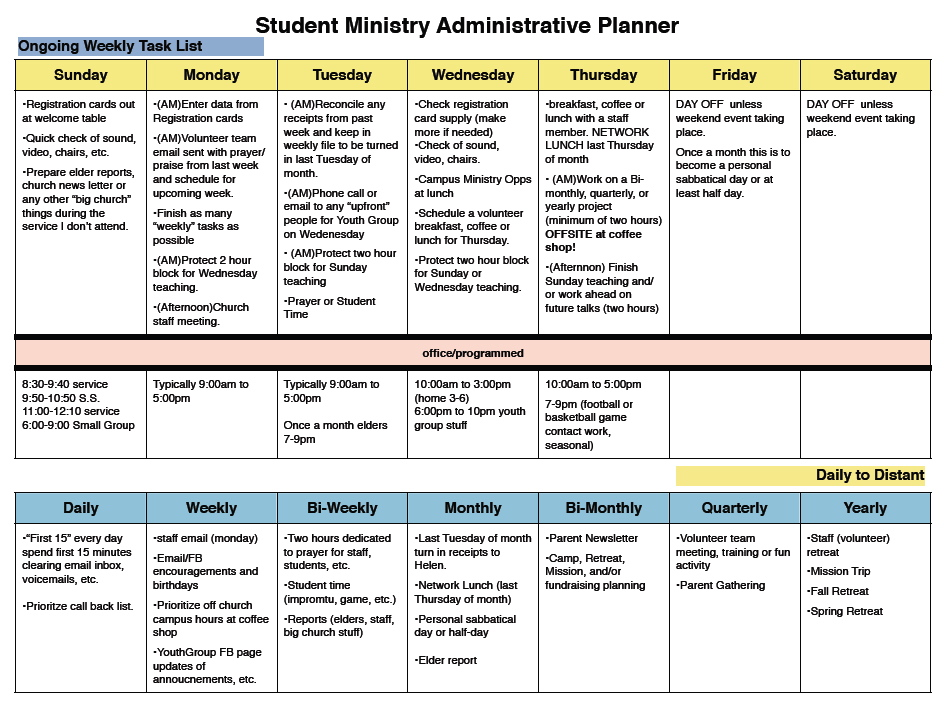
The following are some suggestions to give yourself a little overview of your ministry life and the landscape of the year, it’s just the first of a two step process for the day (be patient).

  • Create a list of the “majors” in your ministry (sacred cows and regularly scheduled programs): This list should include youth group night, Sunday school times, small group time, all the normal camps or retreats you do, etc. You’ll probably add to this list as you think through the following lists as well…
  • Make a separate list of your typical weekly meetings: This list may include staff meetings, one-on-ones, network meetings, etc.
  • Jot down a third list of the weekly tasks that are obvious to you: You need time to study for messages, time to return calls, plan for programs, set up chairs, powerpoint creation, etc.
  • Write down (4th list) the things you like to avoid that take time (that is, if they haven’t already been listed above): For me this was stuff like data entry, return phone calls (I’m much better with email), reports for committees or elders, financial matters, etc.
  • Create a 5th list of the spiritual and relational stuff you wish you had more time to do: This list, for me, would have included more prayer time, personal normal sabbath, more prayer time, long term study for a teaching series, time of being mentored (not just mentoring others), more prayer time, personal evangelism, more prayer time.

Now that you’re overwhelmed again with all the stuff you can/should/need to to, you’re going to create a chart that helps you to see that some, even most, of the stuff can get done if you’re smart about where you place these items in your chart (as you add them to your chart, scratch them off your lists).

A couple tips:

  1. Be realistic… I have friends who love to study the Word.  In fact, I love to study the Word.  But the reality is, I couldn’t be effective at being a Youth Pastor if I was spending 10-12 hours on each talk.  I typically had 2 or 3 messages each week (not including the semi-regularly scheduled preaching in “Big Church”).  I would have had to neglect other areas of ministry–namely shepherding people– if I were to spend that much time on each talk.  The same could be said for other areas, not just messages.  So, be realistic about how much time you actually need to spend on emails, financial matters and messages.
  2. Understand your season… If you’re creating this chart while in the midst of planning a camp, retreat or mission, you’re probably overwhelmed with how long things take. You may want to wait until after the major event to give yourself a more realistic view. In addition, understand that this chart is just an overview, not a “have to” list.  This is YOUR chart, it can change and it isn’t a legalistic formula (I hope).
  3. Don’t celebrate your busyness… You are going to have to come to the realization that you simply can’t do it all, your above created lists may be so long that an 8.5 x 11 piece of paper isn’t even big enough for your Sunday tasks.  This is when you need counsel. And probably counseling. Seriously, have someone help you pare down your list/chart.  Don’t be the Pied Piper and try to do it all yourself.  Begin to recruit others around you to do some of the stuff you don’t like or aren’t good at.

StudentMinAdminPlanner (larger view)

In Word, Pages or even Excel, create for yourself a simple chart, like the one above, where you plug in those lists that you’ve created.  Take this bad-boy to church, give one to your spouse and begin to operate with it as a bit of a check-list.  In a couple weeks you’ll see that you need to make some changes or perhaps you’ll find that you’re not quite the ANALytical thinker and need more of a “philosophical” approach that I’ll attempt to take a crack at next week.

Last… remember you’re called to minister to students, leaders and parents.  This is a great calling. I am excited that you’ve been called to it and even though the words don’t come often enough, I’ll say them again.  Thank you!

Grace,

Brian

Thanks to Wescott for letting me adapt the simple framework of his chart for this blog post.

Three-For-Thursday: BIG Announcements

Some things have been in the works for a number of months that I have not been at liberty to discuss publicly on the blog… well, now I can!  Though I have posted little things here and there through Facebook, I can finally let the cat out of the bag (someone want to give me a history report on that phrase?) and give you my “Three-For-Thursday” of three big announcements for Youthmark!

Before I get to the three-for-thursday, let me start by saying if you are a Youth Pastor/Director or a volunteer in Youth Ministry, we’d love to have you join us this year in training your students for Mission51!  We believe in and want to provide wonderful one week mission experiences, but we emphasize the other 51 weeks of life that mission needs to take place as well.  Some groups join us for a full Youthmark Mission Venture, whereas others already have a mission trip they are doing, but join us for the training process through our Mission51 materials (including curriculum, spring retreat and foll0w-through materials).  Perhaps this is something you should do as well?

Okay, I needed to start there to give a little background, then on top of that we realize many of our churches will be joining us in Alaska, Hawaii, Canada or in a small town in the continental U.S.  However, we realize that mission is not just here… it is “there” as well.  It truly is Anywhere and Anytime.  Therefore, I give you our BIG announcements…

  1. Costa Rica! We are so excited to dip our feet deep into the International waters in offering trips to Costa Rica!  One major element and reason for Costa Rica is that as an organization we want to always emphasize Mission51 (everything we do “there” should be done “here”).  Quite simply, we want our participants sharing the Gospel and Serving.  Well as we live out the great commission and make disciples in the uttermost areas, we will be able to do this without a major language barrier.  English is taught through ninth grade in Costa Rica.  Picture it, we’ll have students in C.R. hoping to practice their english, while we have our students hungry to share the greatest news ever (JESUS) with our native tongue!  While in C.R. our teams will be helping an about-to-launch Church called “The Bridge.” We’ll serve the local community in San Jose, but also reach out to the poor in the rural areas, even out as far as the beautiful coast!
  2. Mexico! This last year we ran a test-market of about 220 down to Mexico through a local denomination.  Mission51 training and a partnership with Mexico Caravan Ministries proved to be a wonderful tag-team (not to mention the great youth and youth leaders from ConvergeNW).  So, just a week or so ago I went down to Mexico and met with the leadership of Mexico Caravan Ministries and we formed an alliance.  I’m very excited for our teams to be trained by Youthmark, but then have the expertise of MCM on the ground with them as they build three homes for three needy families, have a unique customized team experience and then do a final one-day work project as a team.  This is going to be awesome!
  3. Spring Trips! We’ve had a number of requests over the last few years for spring-break mission options.  With our international options now available, we’re able to offer both Mexico and Costa Rica as Spring Break options!  So now we’ll be able to offer international trips in both the Spring and Summer and then ALL of our trips during the summer!

I am so excited about the future of Youthmark.  I truly LOVE my job/calling.  Just today, while talking with my local network on the south-east side, I found myself in awe of the work of the Lord as I heard Youth Leaders testifying about what God is doing in raising up young people with a passion for the lost.  I really hope that no-matter where groups go on a mission trip, that they emphasize the 51 weeks outside of the mission!  Let’s be on mission all the time!

I hope we see many Youth Pastors come and check out this Mission51 stuff and hear about all our Youthmark Mission Venture options (not just Mexico and Costa Rica) at one of our FREE lunches.  Register for a lunch by clicking here.

Now… let’s live out Mission51!

Grace,
Brian

P.S. If we don’t have a lunch near you, this shouldn’t stop you from inquiring about a YMV or Mission51 materials!  In fact, it may be time to have a lunch near you, we just need people on the ground pushing it with us!  Let’s talk!

SMS: Authority Relationships

Seems people are once again asking, “how come Youth Pastors don’t stick around very long?”  Depending on which expert you ask, the national average for a Youth Pastor tenure at a church is anywhere from seven months to four years.  In my own research/guesstimations I’d put the “average” at about 3 years.  Yes, there are those who are only at a church for six months, but there are many who stick for 8-10 (or even more) years.

I’m not so interested in knowing the exact “average,” I’m more concerned with the initial question slightly re-phrased, “why do Youth Pastors leave?” Well, as a person who did leave, I had a variety of contributing factors for leaving, as most do.  However, the most common issue I find among the departed is some sort of issue they had/felt/ignored with someone in authority.  Quite often that authority is/was the Senior Pastor.

So today, readers of the SMS blog series, I’d like to tackle the issue of the Senior Pastor and Youth Pastor relationship.  Namely, I’d like to give a little bit of advice to the Youth Pastor on how he/she may help this relationship and perhaps lead to longevity in the Youth Pastorate.  After all, ultimately it is the kids who are getting hurt the most with the turnover rate.  With this hurt, it leads to questions… leaving the students, parents and others with one person to blame–the Youth Pastor for leaving. Which then leads the ex-Youth Pastor with a tough choice… “do I try to leave on the high road even though I am being pelted by this bus I’ve been thrown under or do I ‘expose the truth?'” First piece of advice: TAKE THE HIGH ROAD (shut your mouth, smile a lot and bless the people you’re close to on your way out)! The bride of Christ (the Church) and her reputation is worth much more than the few people you are trying to get to think better of you.

Okay, now that that rant is over, how do you, Youth Leader, attempt to build or improve the relationship with the authority in your life?  Here are a couple ways I’d suggest (NOTE: for the sake of writing, I am using the generic “him” for the  authority role)…

  1. Have His Back. Don’t even need to get into the Bible-lessons we could all preach about gossip and slander, but you should be the first to not entertain gossip about your Senior Pastor.  Believer you-me, you’ll have the opportunity to hear it, but please do run from it, you’ll be blessed because you did.  Know this–you will not agree with everything he does, but this does not mean that you have license to share that with others or to entertain those conversations with others.  If/when those conversations are brought up (when slander is being hurled or  when gossip being disguised as a “prayer request” comes knocking at your door) be quick to show and share of your support of the authority figure.  Take the complaining one with you to the pastor and begin with the posture of support for your Pastor.*  Again, though you may not agree with everything philosophically, theologically or even methodologically, you can still be united in purpose and protection of one another.  You make the first move and be his biggest support outside of his family!  *Note, when a serious accusation is being made or when you know of a specific sin area in the life of the Pastor, please do follow Scripture in the Biblical manor of confrontation (Matthew 18, 1 Tim. 5:19, Titus 2, etc.)
  2. Bless Him the Way You Would Like To Be Blessed! He probably makes more money than you, he probably has a bigger expense account and he probably already receives more “thank you” notes than you.  So what?!?  You love it when someone takes you out to lunch, you are appreciative of the note of encouragement and you may very well love it when words of affirmation are spoken of you… The problem, these don’t happen all that often.  Having been around a lot of Youth Pastors and Pastors alike, I know that both are typically under appreciated (I do celebrate that there are some churches that truly get it and do love and appreciate their leadership well).  Bottom line, look to bless the way that you’d like to be blessed.  Look to do this with no-gain in mind, other than the blessing of being a blessing.  This will go miles (or Kilometers for my friends all over the world) in your relationship.
  3. Stay on His Radar. Because many Youth Pastors are not all that administrative, this could take a little extra effort, but do your best to keep your life in front of him.  In other words, communicate well.  What I typically did (not just for the Pastor, but for the office staff as well) was shoot off my rough/estimated weekly calendar each Monday.  This was something they didn’t need to live by, but if they needed to reference it later, it was there.  If the Pastor seems to think you’re communicating too much, he’ll let you know, otherwise, just continue to shoot him a copy of your email to your staff (include him as a bcc), include him in occasional youth ministry informational meetings and invite him to key events–not because you want him to do anything, just so he knows he’s welcome and wanted.  It goes a long way for the youth as well to know that the two of you are close, trust each other and want each other involved in one-another’s ministries.

Too often there is a disconnect between Youth Pastor and Pastor.  My hope is that Youth Pastors can be proactive in this relationship and really work on the small things like great communication, occasional blessings and protection from the nay-sayers.

Soon I’ll reverse this and perhaps take a crack at writing a blog “How to have a good relationship with your Youth Pastor”… Then you make sure someone, besides you, of course, gets the Senior Pastor to read it!  Stay tuned!

Grace,

Brian

SMS: “Student Leader” Dangerous Title (pt. 2)

If you didn’t catch the “Student Leader” A Dangerous Title from last week, you will want to read this first.

I am not sure why the title “Leader” is as glorified as it is.  This last week I attended the National Youth Workers Convention in San Diego.  As I walked through the exhibit area of the convention I was bombarded with signage advertising “Leadership.”  Is it truly our goal to have student become “leaders?”  Perhaps it is just semantics, but my primary goal as a Youth Pastor was to see student develop and mature in their relationship with Christ.  Sometimes this brought about some great “leadership” skills and others became “leaders” in areas that few would ever notice.

Starting with the premise that the title “Student Leader” isn’t necessary, but Student Leadership is a given (meaning: it naturally happens, regardless of title), I would like to continue discussing this subject by providing some specific suggestions for those of you in Youth Ministry who are looking for practical ways to give students ownership within the ministry of the church.

As you mentally peruse your student ministry roster, as you envision those beautiful faces walking through the doors of your youth group, what are your goals for those students?  Is it that they become “great leaders?”  That wasn’t my goal.  I actually envisioned them becoming greater followers.  Putting pressure on them to “perform” is exactly what most everyone else is doing in their life.

  • Get better grades
  • Make varsity
  • Score more points
  • Get more girls/guys
  • Strive to get a raise
  • etc.

I don’t think we need to add “become a student leader” to that fold…  However, if you ask underclassmen what they for in their time in your group, don’t be surprised if they say, “become a leader.”  This can happen regardless of whether you have a Student Leadership Team or not.

However, “team” is a concept I believe we can look to develop.  I do believe there are ways you can still accomplish the goals you may have for a Student Leadership team, but do so without the undo pressure of trying to become a title.  Here are a few suggestions.

  1. Utilize Seniors every-year.  Because of age and stage give the seniors the “untitled” leadership role each year.  I did this by creating the “Senior Thing.”  This  was a retreat I did each August with my senior-to-be.  At this retreat we bonded as a team (through initiative games and discussions, prayer and encouragement, etc.).  I would start by saying, “it’s your senior year, the underclassmen look at you as leaders, the question is, how are you going to lead?”  They came to the realizations that they are leaders by default (because of age), furthermore, they began to understand that leadership can lead down a number of different paths.  Perhaps instead of a title of “Student Leader” you can equip and empower your upperclassmen every year by utilizing them to dream, scheme and pray with you, then utilize them within the student ministry according to their gifts.  This dramatically changed the “senior fall-out” I had experienced the first few years of ministry, seniors understood the role they could play in the future generation by serving the youth group rather than feeling like youth group was still for them.
  2. Create Multiple Teams.  As students develop they begin to discover their gifts and skills.  Giving students natural outlets to utilize these talents will benefit the student and the youth group.  The obvious teams may come to mind: worship, service (community and church) drama and even programming (camps, upfronts, etc.).  But what about the not-so-obvious? Like assimilation/follow-up to newcomers, teaching, prayer, encouragement, missions, writing, etc.  Keep in mind that students typically don’t need “more” on their plates, however, creating opportunities where students can discover and develop gifts and talents is essential to their spiritual growth.
  3. Situational Leadership.  Instead of having “Student Leadership” as a full-time club/team, what if you gave students the opportunity to lead for a season?  Perhaps you rotate by class or small group but give different groups the opportunity to lead a youth group night, an outreach event or even a retreat?  In these scenarios they will see it as a special occasion and not something the have “arrived at.”  However, you’ll see students rise to the occasion and begin to understand that all aspects of the body are needed.  Some will become administrative, others will look to be in the “lead” role upfront whereas others will strive to be behind the scenes and lead that way.

In all of these suggestions and many others you can think of (and please comment), I believe we (as Youth Leaders) need to shepherd, affirm, encourage (and correct when necessary) and look to support students in becoming a more mature follower of Christ.

It’s such an affirmation to be called a “leader” in the eyes of the world and is typically a slam to have someone say, “you’re such a follower,” however, this is exactly what we’re called to be.  The question, are we, as Youth Leaders, modeling true follower-ship?

Grace,

Brian

(SMS and) Three-For-Thursday: Evangelism Isn’t Optional

I recently ran into my good friends from Dare 2 Share; they were preparing to teach “Unleashing THE Cause” to a group of Youth Leaders who had gathered for this specific training.  In our brief chit-chat, while attendees began to populate the seats, we were able to discuss one of the biggest issues organizations like D2S and Youthmark face–Evangelism is just not a popular subject, in fact, one may say it is a very unpopular concept.  I honestly had someone write to me recently speaking about Youthmark Mission Venture training materials, the comment “this stuff is just too evangelistic.”  Thank you.

Picture this…

  • The Worship concert will draw a huge crowd, even in a bad economy.
  • The Class on “Manorexia” or the one on “Why He likes He” will both be packed.
  • The Discussion group gathered for a conversation about Water will be buzzing.
  • Evangelism… waitwas that a cricket I heard?

I have absolutely NO problem with the subjects listed above. In fact, if at a conference, I would be very interested in attending each of these.  I believe in worship, educating myself in issues of counseling and sexuality and certainly believe we had better look for ways to reach the needs of the worlds hungry, poor and orphaned.

Knowing that I certainly have more (Christian) adults reading my blog than I do high school (or younger) students, I will start by saying THIS BLOG POST IS FOR YOU!

Specifically, to the Christian… evangelism may not be your gift, however, it is your calling (Acts 1:8, Matthew 28:19-20, 2 Timothy 4:5, Mark 6:7, 12, etc.).

I have the privilege of working with youth and training them for what we call “Mission51” –that is, training for the 51 weeks of life outside the mission.  Yes, Youthmark provides top-notch mission ventures, but our long-term sustainability as a ministry and our life-blood is that each participant be committed to living out and sharing about Jesus for EVERY week of his or her life!

I believe that teens should be the best evangelists we have.  Wait? Doesn’t that contradict what I said above?  Didn’t I say this blog was for adults?

Let me repeat, I do believe teens should be the best evangelists we have in America.

  • They say, 80% of Christians in the U.S. trusted in Jesus at the age of 18 or younger.
  • It is also proven that nationals reach nationals far more effectively than a person from a different culture.

Therefore, I surmise, American teens are our best hope of reaching the lost in America.

Instead of us putting this on them (teens) and expecting them to do it, let’s look at three reasons they aren’t doing it.

  1. They fear they don’t have the right words to say (I wouldn’t know what to say if someone asked me about salvation).
  2. They fear rejection (I don’t want this person to hate or reject me)
  3. They have never had it modeled (why should I do it, you’re not)

Evangelism… I must admit, I’m not a big fan of the word itself.  However, I am HUGE fan of the scriptural mandate and the author of said mandate.  The reason I am not a fan is because so many have soiled the name, “evangelized” with the wrong message (namely, works righteousness) and de-graced the beautiful Gospel of Jesus.

However, these above three reasons for non-evangelism remain, and today’s “Three-For-Thursday” give the three ways YOU (Christian Adult) can help a teen become a better evangelist.

  1. Find someone YOUR AGE and share the Good News. What if we, those of us aged 19-99 (yep, I think you’re exempt at 100… joking of course), took the call from Jesus seriously and we engaged in evangelism at a peer level? We need to be in the business of peer-to-peer evangelism.  You’ll probably discover the three reasons teens aren’t doing it are the very reason you have chosen not to obey as well.
  2. Discover the best way for you to share your faith.  In order to discover something of this nature, you’ll find that you actually have to try it more than once.  Some really like the Four Spiritual Laws.  Others are really good at sharing the Romans Road; I know a number of people who like Dare 2 Share’s G.O.S.P.E.L. acrostic.  Me?  I’m developing a methodology for Youthmark, however, I will say that I firmly believe in a relational evangelism model that includes me sharing not just my story, but God’s story as well.  To be honest, I think ANY of the above (and many others) are great tools, but the key– you need to figure out how to relationally engage (and love) people and look for entry points into their life so that you can share the greatest news ever–Jesus dying on the cross and rising again to provide THE way of salvation for those who place their trust in Him.  With repetition you will discover the way you are most comfortable and confident in sharing your faith.
  3. Make evangelism be only one part of the real call… DISCIPLESHIP.  We are not called to just “evangelize” all nations, we are called to “make disciples.”  This simply means that we are to spiritually nurture others to maturity in Christ.  If a person doesn’t know Jesus, we must first evangelize in order to nurture.  So, as you work on number one and two above, understand that you are called not to have great words to say as an evangelist, but to be a person of discipleship.  Thank the Lord for the church, we are not alone in discipleship, we get to share in this journey… however, you, as an individual are called to do the work of an evangelist!

Notice that none of the above even deal with direct adult-to-teen training.  I am just more convinced today that the real issue for why students are not doing evangelism is that they have not had it modeled (reason #3 listed above as to why they aren’t sharing).

Adults, as we discover the words to say, as we begin to understand that the rejection we face is actually a person rejecting Christ (not us), we will then be able to have voice with a teen.  We will be able to talk about our “success” stories in evangelism… by the way, success in evangelism is just about being faithful with sharing, the Holy Spirit gets to do the work of saving!

Let’s be successful so that our best evangelists will experience great success in the future!

Grace,

Brian